




How to Calculate the Right KVA Rating for Your Generator Set
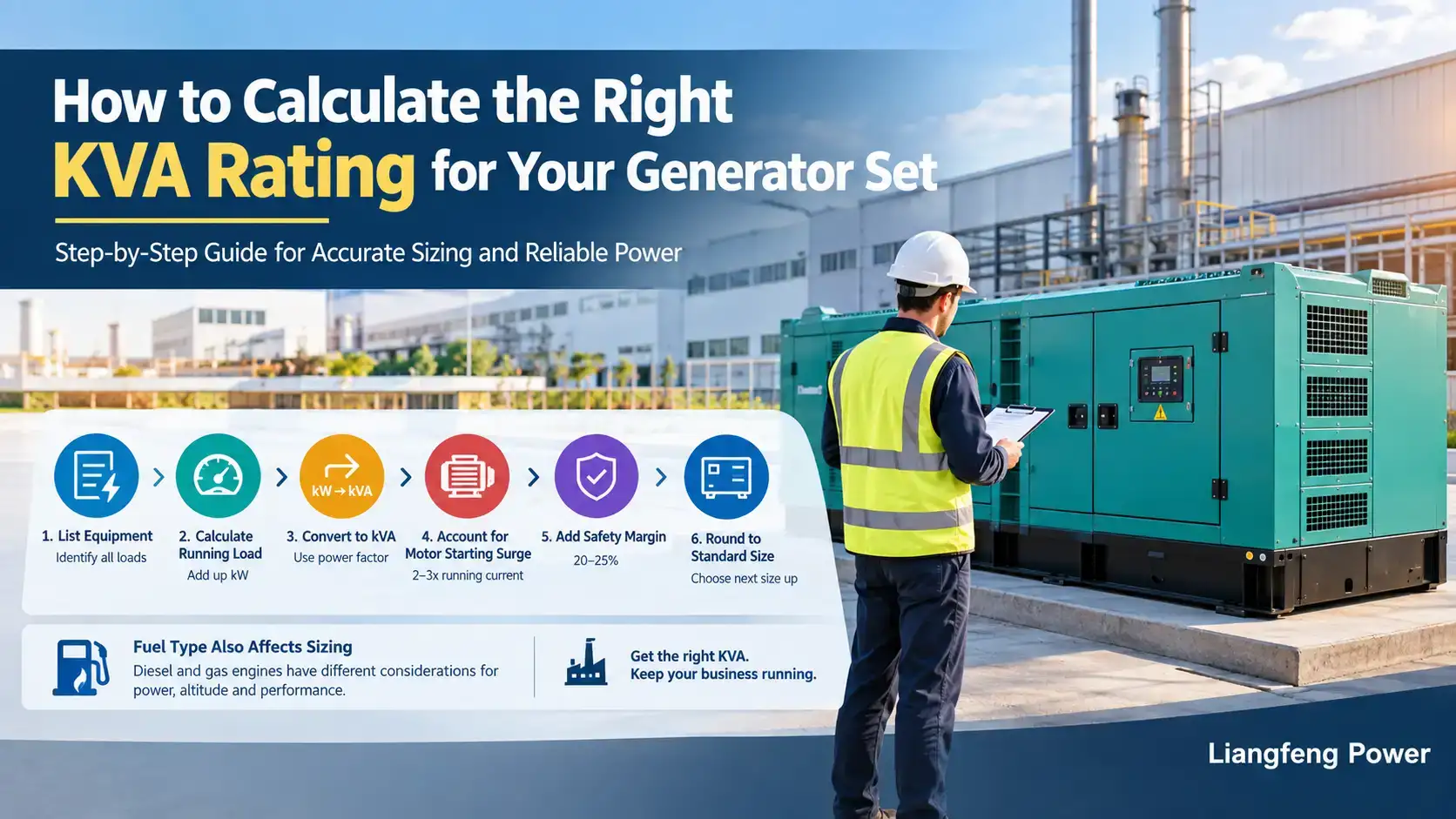
Getting the sizing wrong on a generator set is one of those mistakes that doesn't show up until the worst possible moment. An undersized unit trips out the moment a large motor kicks on, while an oversized one burns extra fuel and never runs efficiently at partial load. Neither outcome is obvious from a spec sheet alone, which is why so many buyers end up second-guessing their purchase after the fact rather than before.
The good news is that sizing isn't guesswork once the core concepts are understood. It comes down to knowing the actual power demand of a facility, understanding how motors behave when they start up, and building in enough margin to handle real-world conditions rather than ideal ones. Skip any of these steps and the calculation looks fine on paper but falls apart the first time a compressor or pump kicks in.
This guide walks through the calculation step by step, covering the difference between kVA and kW, how to account for motor starting surges, and where fuel type introduces its own considerations. By the end, the process becomes a repeatable method that can be applied to any load list, rather than something left entirely to a supplier's estimate.
Understanding kVA vs kW
Before running any numbers, it helps to understand what these two units actually represent, since confusing them is where a lot of sizing mistakes begin. kW (kilowatts) is the real power that does actual work, running motors, lighting, and equipment. It is the portion of electricity that gets converted into something useful, whether that is spinning a motor shaft or powering a light bulb.
kVA (kilovolt-amperes), on the other hand, is the apparent power, and it includes both that real power and the reactive power needed to maintain voltage across the system. Reactive power does not do useful work directly, but it is still something the generator set has to supply, particularly for loads like motors and transformers that rely on magnetic fields to operate. The relationship between kW and kVA is defined by the power factor, typically around 0.8 for most industrial setups, which is why a generator set has to be sized in kVA rather than kW alone. Sizing based on kW figures alone consistently leads to an undersized unit, since it ignores this reactive component entirely.
Step 1: List All Equipment That Will Run on the Unit
The sizing process starts well before any formula gets applied, with a complete and honest inventory of everything that will draw power from the generator set. This means walking through the facility and noting down every piece of equipment that could realistically run at the same time: lighting fixtures, HVAC systems, motors, pumps, compressors, computers, and any other electrical load, no matter how minor it might seem on its own.
This step matters more than it might initially appear. Missing even a handful of items during this inventory is one of the most common causes of undersized systems, and the mistake often does not surface until months later when a new piece of equipment gets added or a rarely-used machine finally gets switched on alongside everything else. Relying on memory or a rough mental estimate tends to leave gaps, so it helps to physically walk the facility, check electrical panels, and cross-reference equipment lists with maintenance or procurement records rather than trying to recall everything from memory. For larger facilities, involving different department heads or shift supervisors in this process often surfaces equipment that would otherwise get missed, since the person doing the calculation may not be aware of every piece of equipment used across different areas or shifts.
Step 2: Add Up Total Running Load in kW
Once the full equipment list has been compiled, the next step is determining how much power each item actually draws while running under normal conditions. This running wattage is typically printed directly on the equipment's nameplate, though it can also be found in the manufacturer's manual or, in some cases, by contacting the equipment manufacturer directly if neither of those sources is available.
It's worth being careful here to distinguish between running load and any other figures that might appear on the same nameplate, since some equipment lists multiple ratings for different operating conditions. Once each item's running wattage has been recorded, all of these figures get added together to arrive at the total running load in kW. This number represents the facility's steady-state demand, meaning what the system needs once everything is already running smoothly, not the higher demand that occurs briefly when equipment first switches on. That starting demand gets addressed separately in a later step, so at this stage the focus stays purely on steady, continuous operation.
Step 3: Convert kW to kVA Using Power Factor
With the total running load calculated in kW, the next step is converting that figure into kVA, since that is the unit generator sets are actually rated in. This conversion is done by dividing the total kW figure by the power factor, which for most mixed industrial loads sits around 0.8, though it can vary depending on the specific mix of equipment involved.
To put this into a concrete example, a facility with 65 kW of total running load divided by a power factor of 0.8 works out to roughly 81 kVA. This 81 kVA figure represents the base apparent power requirement before any further adjustments are made for starting surges or safety margins, both of which get layered on top in the steps that follow. It's a useful checkpoint number to keep in mind, since it forms the foundation that the rest of the calculation builds upon.
Step 4: Account for Motor Starting Surges
This is often the step that catches buyers off guard, because the numbers involved can be surprisingly large compared to the running load calculated earlier. Motors, compressors, and pumps do not draw a steady amount of current the moment they are switched on. Instead, they pull a significant surge of extra current for the first few seconds as the motor works to overcome its own inertia and get up to normal operating speed. This starting surge is commonly two to three times the motor's normal running current, and in some cases it can be even higher depending on the type of motor and how it is started.
Even though this surge only lasts briefly, typically a few seconds at most, the generator set still has to be capable of supplying that peak demand without tripping a breaker, stalling, or causing a significant voltage dip that could affect other equipment running on the same system. To account for this properly, it helps to identify the largest motor loads in the facility and calculate their starting kVA separately from the rest of the running load. In many real-world cases, this starting figure ends up being higher than the total running load calculated in the earlier steps, which is exactly why skipping this step tends to produce a generator set that looks adequately sized on paper but fails the very first time a large motor actually starts up.
Step 5: Apply a Safety Margin
Once the running kVA has been calculated and the starting surge has been factored in, the next step is adding a safety margin on top of whichever of those two figures turns out to be higher. A margin of 20 to 25 percent is standard practice across most industrial applications, and it serves several practical purposes rather than simply being an arbitrary buffer.
This margin helps absorb voltage dips that naturally occur during motor starts, gives some breathing room for future load additions as a facility grows or equipment gets upgraded, and accounts for the reality that equipment rarely performs exactly to its nameplate specifications after years of real-world use. Wear, environmental conditions, and manufacturing tolerances all mean that actual power draw can drift slightly from what the nameplate originally stated, and a generator set with no margin built in has no room to absorb that drift without running at, or beyond, its rated capacity on a regular basis.
Step 6: Round Up to the Nearest Standard Size
After working through running load, starting surge, and safety margin, the final calculated figure rarely lines up perfectly with an off-the-shelf product, since generator sets are manufactured in standard capacity increments rather than being custom-built to match every buyer's exact calculated number. Once the final adjusted kVA figure has been determined, the appropriate next step is rounding up to the nearest standard size that is actually available on the market.
It's worth emphasizing the direction of this rounding, since choosing a standard size below the calculated figure defeats the entire purpose of the margin that was just built in during the previous step. Rounding up, even if it means moving to a noticeably larger standard size, keeps the safety margin intact and ensures the unit will perform as expected once it's actually installed and running under real conditions rather than falling short the moment demand spikes.
Fuel Type Also Affects Sizing
The six steps above apply regardless of which fuel type a generator set runs on, but diesel and gas engines each introduce their own additional considerations that are worth understanding before finalizing a decision, since treating both fuel types identically during sizing can lead to a unit that underperforms in practice even though the core calculation was done correctly.
Diesel Generator Set Sizing Considerations: Diesel generator sets are typically sized around their prime rating rather than the higher standby rating, since prime ratings account for continuous operation and the kind of unplanned variables that show up in real-world use, things like fuel quality fluctuations and runtime that ends up longer than originally planned. Altitude and ambient temperature also derate diesel engine output, meaning a unit rated for sea-level performance under standard conditions may deliver noticeably less usable power at higher elevations, which becomes an important factor for buyers operating in mountainous or high-altitude regions.
👉 Read More: Diesel Generator Set Sizing for Prime and Standby Ratings with Derating Factors
Gas Generator Set Sizing Considerations: Gas generator sets generally have lower power density compared to diesel engines, which means a gas-powered unit needs to be physically larger in order to produce the same kW output as its diesel counterpart. Gas units also tend to be more sensitive to altitude derating than diesel units, largely due to their reliance on a precise air-fuel mixture for proper combustion. As a result, buyers operating at higher elevations often need to size up further with a gas generator set than they would with an equivalent diesel setup in order to reach the same level of usable output at their specific site conditions.
👉 Read More: Gas Generator Set Sizing: Power Density and Altitude Derating Explained
Worked Example: Sizing for a Small Industrial Facility
Bringing all six steps together with a concrete example helps make the process easier to follow from start to finish. Consider a facility with the following equipment running simultaneously: lighting and office equipment drawing 15 kW, air conditioning drawing 20 kW, and electric motors drawing 30 kW, for a combined total running load of 65 kW.
Dividing that 65 kW figure by a power factor of 0.8 gives a base requirement of about 81 kVA. Factoring in the motor starting surges from the electric motors in this load pushes the figure closer to 100 kVA, since motor starting current typically runs well above the steady running figure. Applying a 25 percent safety margin on top of that 100 kVA figure brings the final calculated requirement to roughly 125 kVA. Rounding up to the nearest standard size available on the market, a 125 kVA generator set would be the appropriate choice to move forward with for this particular facility.
Avoiding Sizing Mistakes
Even when the formula itself is applied correctly, a handful of recurring mistakes tend to trip up buyers during the broader sizing process. These include underestimating motor starting surges by assuming running load alone is sufficient, skipping the safety margin entirely to save on upfront cost, or sizing a unit based on its standby rating when the facility will actually put it through continuous, everyday use rather than occasional backup duty.
These mistakes come up often enough, and carry significant enough consequences, that they deserve their own detailed breakdown covering exactly where buyers tend to go wrong and how to catch these issues during the planning stage, before an order is placed, rather than discovering them after installation when correcting course becomes far more costly and disruptive.
Frequently Asked Questions
What is the difference between kVA and kW in a generator set?
kW measures the real, usable power that performs actual work, while kVA measures apparent power, which includes both that real power and the reactive power the system also needs to function properly. A generator set gets sized in kVA specifically because it has to supply both components together, even though only the kW portion ends up doing useful work at the equipment level.
How much safety margin should be added when sizing a generator set?
A margin of 20 to 25 percent above the calculated requirement is standard practice for most industrial applications. This margin protects against voltage dips that occur during motor starts, allows room for future load growth as a facility expands, and accounts for equipment that draws slightly more than its nameplate rating suggests once it has been in service for a while.
Why do motors need a larger generator set than their nameplate kW suggests?
Motors draw a substantial starting surge, often two to three times their normal running current, during the first few seconds after they are switched on. A generator set has to be sized to handle this peak demand rather than just the steady running load that follows, or it risks stalling or tripping a breaker every single time that motor starts up.
Does altitude or temperature affect generator set sizing?
Yes, both factors reduce engine output compared to sea-level conditions at a standard reference temperature. Facilities operating at higher elevations, or in climates that run consistently hot, typically need to size up beyond the base calculation in order to compensate for this derating effect and still deliver the power output originally required.
Should sizing be based on total connected load or actual running load?
Actual running load, meaning the equipment that genuinely operates at the same time in practice, is the more accurate basis to size around. Total connected load often overstates real demand significantly, since not every piece of equipment on-site runs simultaneously, and using that inflated figure as the primary reference point tends to result in an unnecessarily oversized, and more expensive, unit than the facility actually needs.
Conclusion: Getting the Calculation Right the First Time
Sizing a generator set correctly comes down to working through the numbers methodically rather than relying on a rough guess or a quick recommendation handed over during a sales conversation. Total running load, motor starting surges, and a reasonable safety margin, when combined properly, produce a figure that holds up under real operating conditions on-site, not just one that looks reasonable on paper during the planning stage.
Fuel type, site altitude, and how the unit will actually be used day to day all shape the final sizing decision, which is why it's worth working through each of these factors individually before committing to a specific capacity. A unit sized correctly from the very beginning avoids both of the costly outcomes discussed at the start of this guide: one that trips under load at the worst possible moment, and one that sits oversized and running inefficiently for years after installation.
Need Help Sizing Your Next Generator Set?
Working through these calculations becomes considerably easier with input from a supplier who genuinely understands how engine type, site altitude, and load profile all interact together in practice, rather than treating sizing as a purely theoretical exercise. As a reliable China generator set supplier, Liangfeng Power works directly with buyers to confirm the right KVA rating for their specific load and operating environment before any order gets finalized.
For anyone planning a generator set purchase and looking for a second opinion on a sizing calculation, reaching out with load details and site information allows our team to help confirm the right capacity for that specific project before a commitment is made.
Featured Articles
A gas generator set loses roughly 3 to 4 percent of its rated electrical output for every 1,000 f
READ FULLA supplier quotes 100 kVA standby and 90 kVA prime on what turns out to be the exact same engine
READ FULLGetting the sizing wrong on a generator set is one
READ FULL