




Diesel Generator Set Sizing for Prime and Standby Ratings with Derating Factors
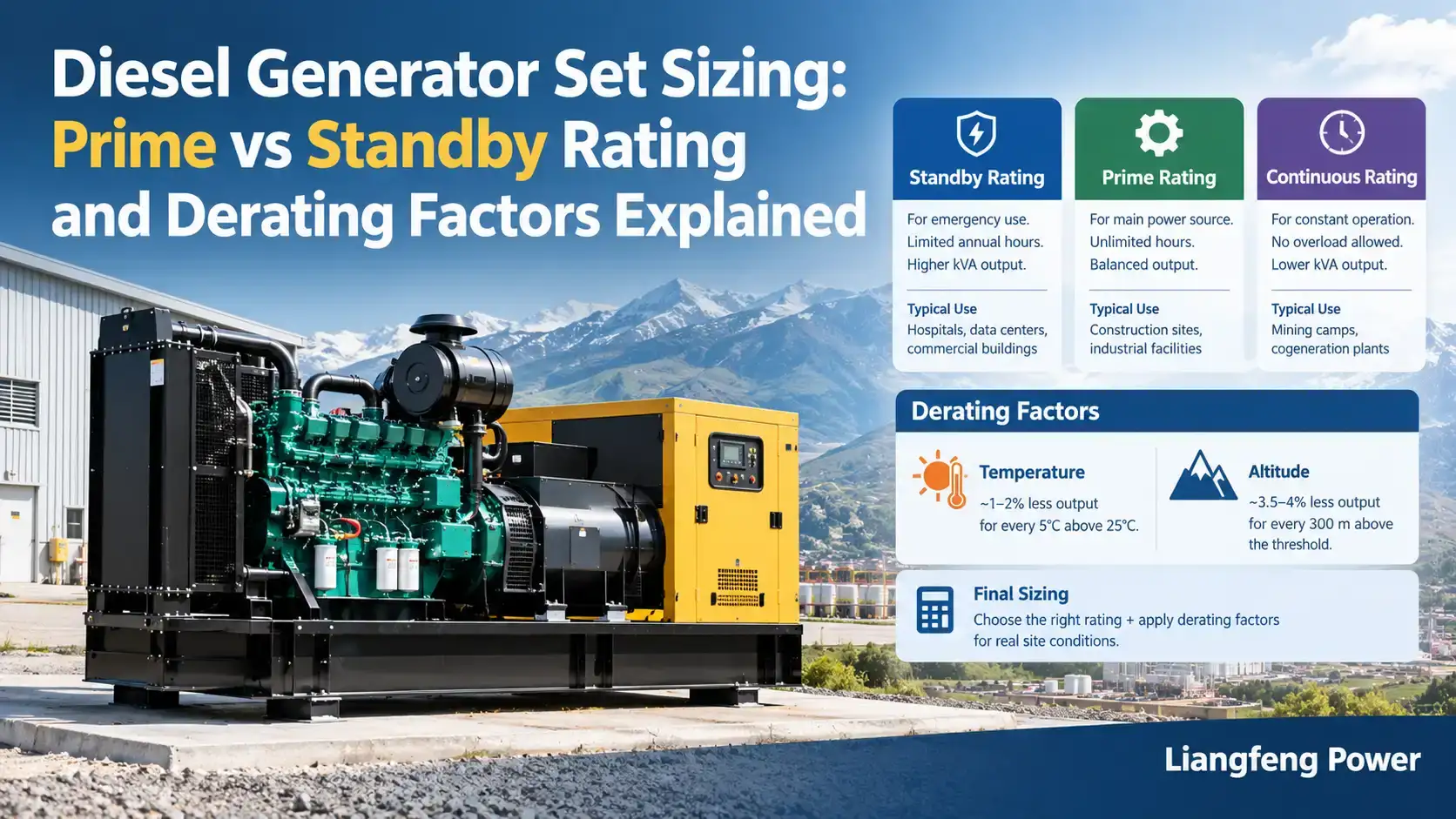
A supplier quotes 100 kVA standby and 90 kVA prime on what turns out to be the exact same engine and alternator. To someone unfamiliar with how diesel generator set solutions are classified, this looks like a pricing trick or a typo. In reality, it's neither, it's the direct result of duty rating, a factor that changes how much output the same physical hardware is allowed to deliver depending on how often and how hard it will actually run.
Most sizing conversations focus almost entirely on kVA capacity and stop there, treating duty rating as a footnote to sort out later. That ordering causes problems. A facility that installs a standby-rated unit and then runs it daily as a primary power source will eventually see thermal stress, voided warranty coverage, and premature engine wear, none of which shows up in the first few weeks of operation. The reverse situation, buying prime or continuous capability for a site that only ever needed occasional backup, isn't dangerous, but it does mean paying for heavier-duty components the site will never call on.
This guide assumes the base kVA requirement has already been worked out using a proper generator set sizing calculation, and picks up from there, breaking down what standby, prime, and continuous ratings actually mean, explaining why identical hardware carries different published numbers depending on classification, and covering how temperature and altitude further reduce the usable output a diesel generator set can deliver once it's installed at a specific site.
Understanding the Three Core Ratings
Before getting into the technical detail behind each classification, it helps to see all three side by side, since they exist on a spectrum defined largely by how often the equipment runs and how much load variation it needs to handle. Standby sits at one end, built for rare, short-duration emergency use. Continuous sits at the other end, built for constant, unchanging operation around the clock. Prime falls in between, designed for extended runtime under a load that moves up and down throughout the day. Each of the three sections below breaks down one of these ratings in more depth.
Standby Rating Explained
A standby-rated diesel generator set exists to do one job: keep a facility running when the utility grid goes down, and then step back once grid power returns. It is not intended to serve as a regular or primary power source under any circumstances, and its entire internal engineering reflects that assumption.
Under the industry standard ISO 8528-1, a standby rating assumes the unit will operate for a maximum of somewhere around 200 to 500 hours per year, depending on the specific manufacturer's published limits, and that its average load over any 24-hour period will stay around 70 percent of the rated output, even though it can handle short bursts at the full nameplate figure. Because this duty is infrequent and short in duration, manufacturers are able to rate the engine and alternator at a higher output relative to their physical size than they would for a unit expected to run continuously. This is exactly why a standby rating on a given piece of hardware ends up looking more generous on paper than the prime rating for that same hardware, a point covered in more detail further down this guide.
Typical applications for a standby-rated unit include hospitals, data centers, manufacturing facilities, and commercial buildings, essentially any site where the grid connection is normally reliable and the generator set exists purely as insurance against the occasional outage.
Prime Rating Explained
A prime-rated diesel generator set solves a fundamentally different problem. Rather than backing up an existing grid connection, it replaces the grid entirely, serving as the primary electricity source at a site for as long as that site needs power.
The prime rating under ISO 8528-1 permits unlimited annual operating hours, but with an important condition attached: the average load over any 24-hour period must not exceed roughly 70 to 75 percent of the rated output. A 10 percent overload allowance typically exists for emergency situations, capped at one hour within any 12-hour window and limited to a set number of hours per year. This average load ceiling exists because a prime-rated unit is expected to accumulate far more running hours over its service life than a standby unit ever will, and the engine and alternator need thermal headroom to manage that sustained heat buildup without wearing out ahead of schedule.
Because of this conservative average load requirement, a prime-rated unit built on the same core engine and alternator as a standby unit will carry a lower kVA figure, not because the hardware is any less capable, but because it's rated with long-term reliability under continuous, variable-load operation in mind. Typical prime applications include construction sites, remote industrial facilities, mining operations, and any location where a reliable grid connection either doesn't exist or isn't a realistic option for the duration of the project.
Continuous Rating Explained
Continuous power, sometimes abbreviated COP, sits at the far end of the spectrum from standby. A continuous-rated diesel generator set is built to deliver a constant, unchanging load for an unlimited number of hours, with no overload capability built in whatsoever.
This is the most conservative of the three ratings relative to the physical hardware, precisely because there's no allowance for load variation or brief spikes above the rated figure. The engine runs at a fixed demand around the clock, which means there's no headroom to absorb a temporary surge the way a prime or standby unit can. Typical continuous applications include off-grid mining camps requiring stable base-load power for years at a stretch, and industrial cogeneration setups where the generator set operates as a permanent, ongoing part of a facility's power infrastructure rather than a backup or primary source that experiences daily fluctuation.
Why the Same Hardware Gets Different Ratings
One detail that catches a lot of buyers off guard is discovering that a supplier's 100 kVA standby unit and their 90 kVA prime unit are, underneath the branding, the exact same engine and alternator combination. This isn't a case of one unit being built with cheaper components than the other. The difference in rated output comes entirely from the operating profile each rating is designed around.
A standby rating assumes short, infrequent runtime at high load, so the manufacturer can safely push the published capacity higher, since the equipment gets long rest periods between uses to recover from any thermal stress. A prime rating assumes extended, near-daily operation, so the published capacity gets pulled back to protect the same hardware from the cumulative wear that comes with running far more hours per year. This is why comparing a supplier's standby quote against another supplier's prime quote for what looks like a similar kVA number creates a misleading comparison. The two figures aren't measuring the same thing, even when they're describing physically similar equipment.
Matching the Rating to the Actual Application
Selecting the right rating comes down to answering a handful of straightforward questions about how the diesel generator set will actually be used, rather than simply picking whichever option has the highest number attached to it.
A standby rating fits situations where a reliable utility grid connection already exists, and the generator set only needs to step in during unplanned outages, typically staying well under the annual hour limits that come with that classification. A prime rating fits situations where the generator set is the main or only power source, where the load moves up and down throughout the day as different equipment cycles on and off, and where the site doesn't have a grid connection to fall back on for an extended period. A continuous rating fits the narrower set of situations where the load stays essentially fixed around the clock, with no meaningful variation to plan around.
One scenario that tends to surprise people involves planned utility disconnections, say, a facility scheduling maintenance that requires temporarily cutting the grid connection. Even though this sounds like a textbook standby situation, the generator set may actually be functioning as the facility's primary power source for that defined window, which can put it closer to prime territory depending on how long the disconnection lasts and how the load behaves during that period.
What Happens When the Rating Doesn't Match the Application
Getting this classification wrong isn't a paperwork issue, it carries real mechanical and financial consequences depending on which direction the mismatch goes.
Running a standby-rated unit in a prime application, meaning treating it as a daily primary power source rather than an occasional backup, pushes the engine and alternator well beyond the thermal limits they were designed around at that output level. Over time this shows up as elevated exhaust temperatures, increased oil consumption, shortened service intervals, and in more serious cases, outright engine or alternator failure well ahead of the equipment's expected service life. Manufacturers track logged operating hours closely, and a warranty claim on a standby unit that's been quietly logging prime-level hours typically gets denied once that usage pattern comes to light.
The opposite mismatch, specifying a prime or continuous unit for a site that only ever needed occasional backup power, doesn't carry the same mechanical risk, but it does mean paying a premium for heavier-duty cooling systems, more robust components, and capability the site will never actually call on. There's also a separate risk worth mentioning here: diesel engines running consistently below roughly 30 percent of their rated load, regardless of which rating applies, are prone to a condition known as wet stacking, where unburnt fuel residue builds up in the exhaust system due to incomplete combustion at low load. This is a separate issue from rating selection itself, but it's closely related and worth factoring into how a unit gets sized and operated once it's installed.
Understanding Derating Factors
Choosing the correct rating only tells part of the story, since the published capacity for any of these three classifications assumes standard reference conditions, typically around 25°C ambient temperature and sea-level elevation. Real-world installation sites rarely match those exact conditions, which is where derating factors come into play, reducing the usable output a diesel generator set can actually deliver once it's installed at a specific location.
Ambient Temperature Derating Explained
Diesel engines lose a measurable amount of output as ambient temperature climbs above the standard reference point. As a general guideline, output typically drops somewhere in the range of 1 to 2 percent for every 5°C rise above that 25°C baseline, though the exact figure varies by manufacturer and engine model. A unit installed in a facility that regularly experiences high ambient temperatures, whether due to climate or poor ventilation around the installation site, needs this factor built into the sizing calculation from the start, rather than being discovered as a shortfall after the equipment is already running.
Altitude Derating Explained
Air density decreases as elevation increases, and since a diesel engine relies on a certain volume of air for proper combustion, that reduced density translates directly into reduced combustion efficiency and lower usable output. A commonly referenced guideline puts the derating at roughly 3.5 to 4 percent for every 300 meters of elevation above an initial threshold, which can range anywhere from 150 to 1,000 meters depending on the specific manufacturer's published data. Sites located at meaningful elevation, mountainous regions or high-altitude plateaus in particular, need this factor accounted for separately from temperature derating, since the two effects stack together rather than one replacing the other.
Combining Rating Selection with Derating for Final Sizing
Rating selection and environmental derating aren't two separate calculations that happen in isolation, they work together to determine the final capacity a diesel generator set actually needs to be sized at for a specific site. The process generally starts with determining the correct duty rating based on expected annual hours and load profile, as covered earlier in this guide, and then applying whatever temperature and altitude derating factors apply to that particular installation location on top of the base rated output.
Skipping either half of this combination leads to a unit that looks correctly sized on a datasheet but underperforms once it's actually installed and running under real site conditions. A prime-rated unit that accounts for load profile correctly but ignores a high-altitude installation site will still come up short on usable output once it's in the field, regardless of how carefully the rating itself was chosen.
Worked Example: Selecting the Right Rating and Derating for a Site at Elevation
Consider a remote industrial facility with no grid connection, requiring continuous power to run varying loads throughout each shift, clearly a prime power application given the lack of grid backup and the variable nature of the load. The base calculation determines a 500 kVA prime rating would meet the facility's running and starting load requirements under standard reference conditions.
However, the site sits at 1,500 meters elevation with an average ambient temperature of 35°C, well above both the sea-level and 25°C reference points those standard ratings assume. Applying an altitude derating of roughly 4 percent per 300 meters above the manufacturer's stated threshold, combined with a temperature derating of around 1.5 percent for every 5°C above the 25°C baseline, reduces the effective output of that 500 kVA prime-rated unit by a meaningful margin, potentially down into the 400 to 430 kVA range depending on the exact factors published by the specific manufacturer. To compensate, the facility would need to size up to the next standard prime rating available that still delivers at least 500 kVA of effective output once both derating factors are applied, rather than ordering a unit rated exactly at 500 kVA under standard conditions and discovering the shortfall only after installation.
Conclusion: Getting Both the Rating and the Derating Right
Sizing a diesel generator set correctly means working through two distinct but connected questions rather than treating kVA capacity as the only number that matters. The first question is which duty rating, standby, prime, or continuous, actually matches how the unit will be used in terms of annual hours and load variability. The second question is how much of that rated capacity survives once real site conditions like temperature and altitude are factored in.
Skipping either question tends to produce the same outcome eventually: a unit that looked correctly specified on paper but falls short, or gets pushed beyond its intended duty, once it's actually running on-site. Working through both the rating classification and the applicable derating factors before finalizing an order is what separates a diesel generator set that performs reliably for years from one that runs into trouble well ahead of schedule.
Looking for the Right Diesel Generator Set for Your Application?
The 500 kVA example above only worked out correctly because the rating classification and the site's altitude and temperature were both factored in before an order was placed, not after. That's the difference proper sizing support makes, and it's the standard Liangfeng Power applies to every diesel generator set order, checking duty classification and environmental derating together rather than treating kVA as a single number to fill.
Anyone sourcing from a trusted diesel generator set exporter for a site with unusual elevation, temperature, or load conditions gets more value out of the process by sharing those specifics upfront. Our team reviews site altitude, ambient conditions, and expected duty cycle alongside the base load calculation, so the unit that ships matches what the site actually needs rather than what a standard datasheet assumes.
Featured Articles
A gas generator set loses roughly 3 to 4 percent of its rated electrical output for every 1,000 f
READ FULLA supplier quotes 100 kVA standby and 90 kVA prime on what turns out to be the exact same engine
READ FULLGetting the sizing wrong on a generator set is one
READ FULL