




Strategic Bulk China Generator Set Sourcing: A Blueprint for Maximum Profitability
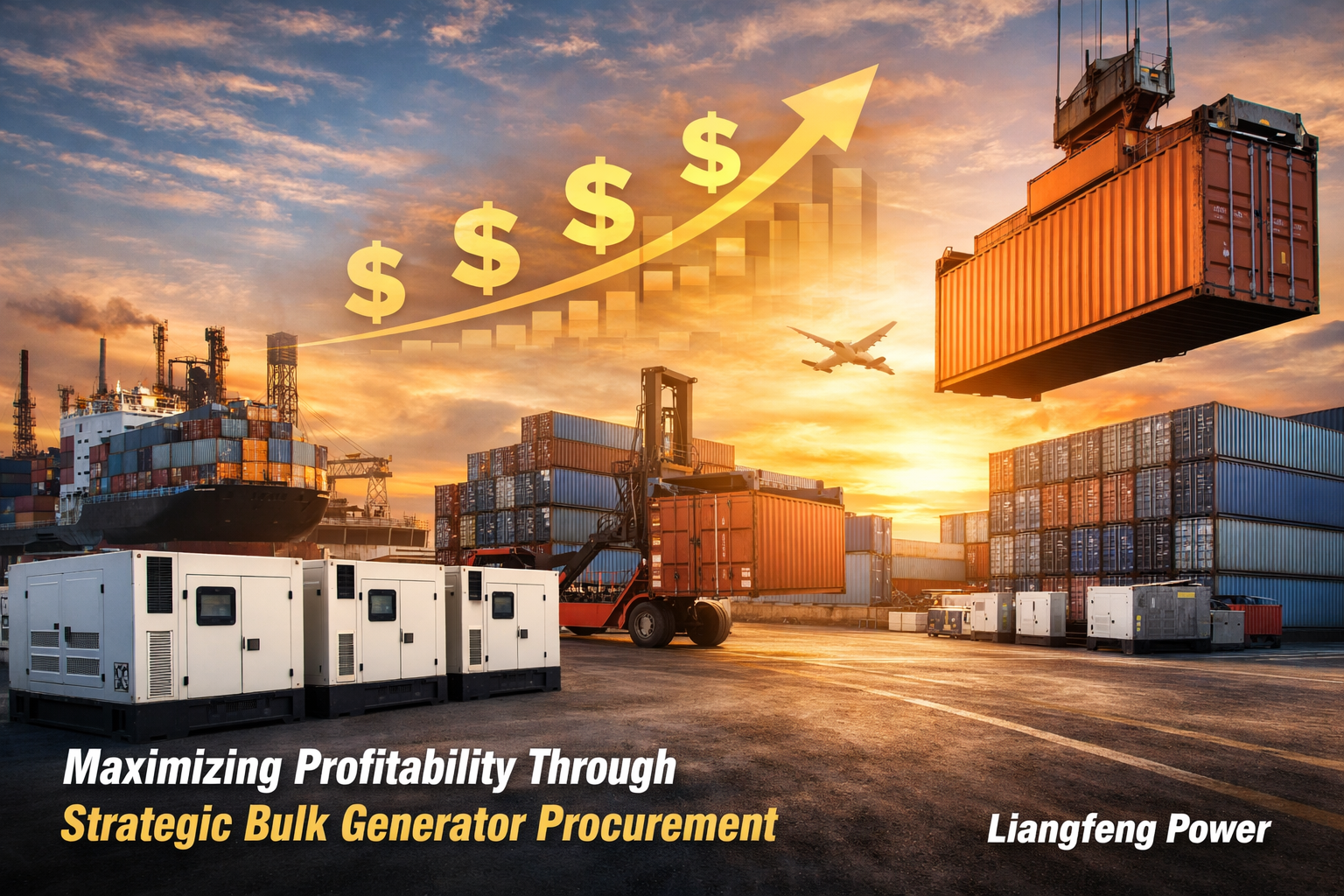
In the high-stakes world of industrial power equipment, the difference between a thriving enterprise and a struggling one often comes down to procurement strategy. When a business decides to purchase China generator sets in bulk, they are doing much more than just replenishing inventory; they are making a calculated financial move to secure genset market stability and expand profit margins. Bulk generators procurement is the engine that drives large-scale distribution, allowing B2B generator sets players to offer competitive pricing that smaller competitors simply cannot match.
This comprehensive guide explores the multifaceted world of volume buying, from the underlying economics to the complex logistics and risk management strategies required to succeed.
The Economics of Buying Generators in Bulk
The fundamental principle behind the bulk procurement of industrial power units is the "Economy of Scale." In simple terms, this means that as the quantity of your generator order increases, the cost of producing each individual unit decreases. For heavy machinery like diesel generators, these savings are substantial. When a manufacturer receives an order for 50 or 100 units of generator sets, their entire production facility enters a state of "continuous flow." This efficiency reduces the time spent on machine setup for each genset, minimizes labor downtime, and allows for more aggressive negotiation with raw material suppliers for the alternators and engines.
Beyond just the purchase price, the economics of buying generators in bulk positively impact your business’s overall financial health. Having a significant volume of power equipment stock on hand acts as a "buffer" against global supply chain shocks. In an era where shipping delays for industrial machinery and raw material shortages are common, a business with a bulk genset inventory can continue to fulfill orders while others are stuck waiting for shipments. This reliability translates into a stronger brand reputation for your generator business and the ability to capture "urgent" market demands that competitors might miss.
Reducing Per-Unit Costs with High-Volume Orders
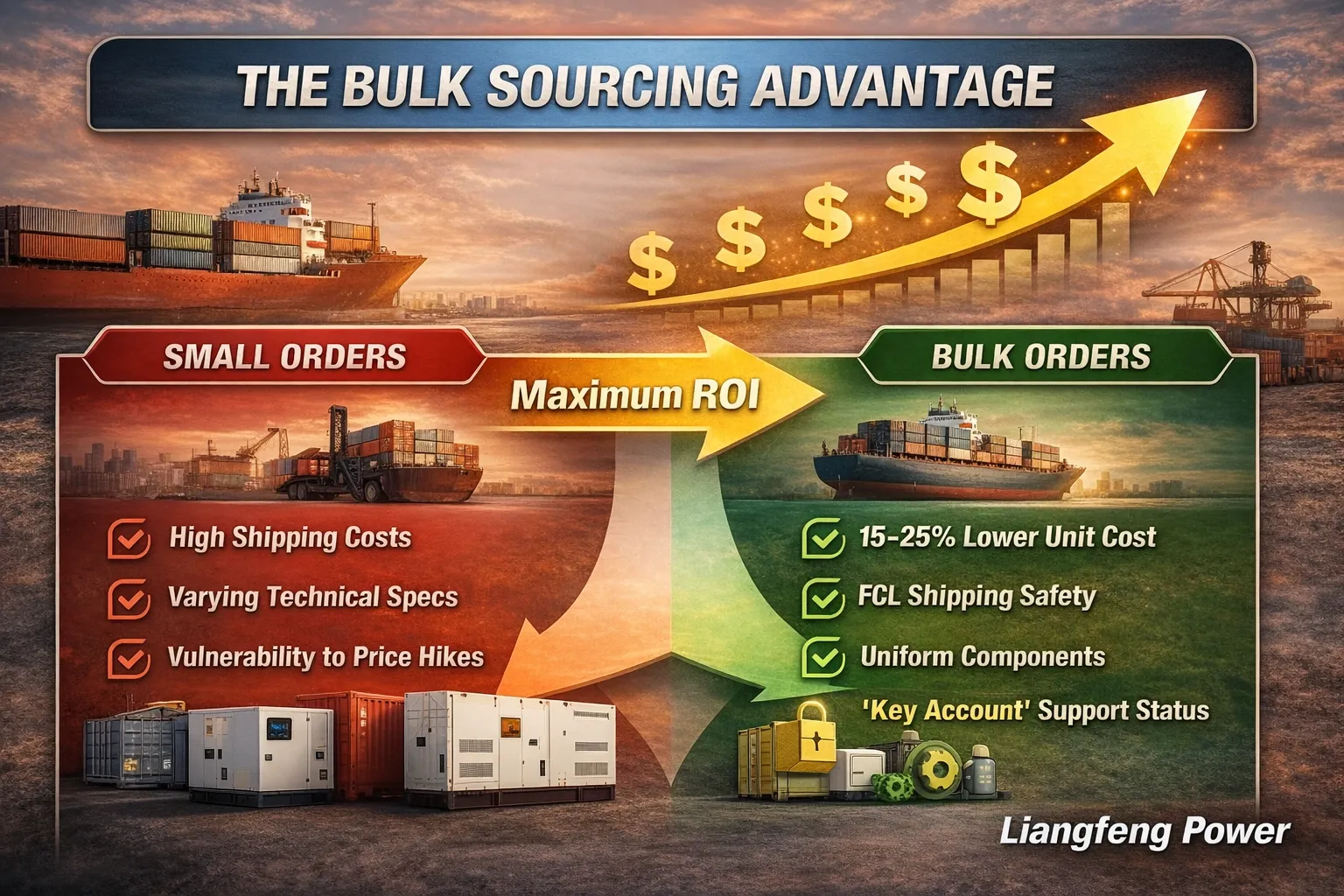
When we discuss reducing per-unit costs for wholesale generator equipment, we aren't just talking about a simple "friends and family" discount. The reduction is based on hard data and the reality of generator manufacturing. Generator set manufacturers have high fixed costs, such as factory rent, engineering research for new engine models, and machinery maintenance. When you place a high-volume order for power units, those fixed costs are spread across more units, lowering the "overhead" attached to each individual generator.
Furthermore, bulk generator buyers gain significant "Negotiation Power." In the B2B world, a buyer who orders 20 containers of generator sets a year is a "Key Account." This status allows you to negotiate not just for lower prices, but for "value-added" upgrades on your gensets. You might be able to secure a premium control panel (like a DeepSea or ComAp) or a more durable soundproof canopy for your silent generators for the same price that a smaller buyer pays for a standard model. This essentially increases your profit margin from two directions: you pay less for the power generation product, and you receive a higher-quality asset that commands a better resale price in your local generator market.
Strategic Stockpiling for Large-Scale Industrial Projects
Industrial projects, such as the construction of hospitals, data centers, and massive residential complexes, require a reliable and consistent power supply system. Strategic stockpiling involves purchasing these generator units well in advance of the project’s peak phase. The most immediate benefit of this for industrial gensets is "Price Protection." The cost of generators is heavily tied to the global price of commodities like copper (for the generator alternator) and steel (for the genset frame). By buying power generators in bulk today, you "lock in" the current price, protecting your project budget from future inflation or sudden spikes in power equipment material costs.
Moreover, stockpiling ensures "Technical Uniformity" across your entire fleet. Whether your project requires a bulk diesel generator for heavy-duty standby power or a bulk China gas generator set solution for continuous, low-emission energy, having technically identical units is a massive advantage for maintenance crews. If you buy units in smaller, separate batches, there is a risk that the generator manufacturer might update a component or change a wiring configuration in between. In a large-scale project, having 100 identical units means one set of spare parts, one type of oil filter, and one standardized training session for operators. This consistency reduces operational complexity and long-term genset maintenance costs.
Managing Logistics for Bulk Power Equipment Orders
Logistics is often the "make or break" factor in bulk generator procurement. Moving one portable generator is a task; moving fifty industrial gensets is a massive operation. When dealing with bulk power equipment, the weight and dimensions are so significant that even a small error in planning can lead to thousands of dollars in port demurrage fees or transit damage to your generator sets. Managing genset logistics effectively means coordinating between the generator factory’s production schedule, the shipping line’s container availability, and your own warehouse’s receiving capacity for heavy machinery.
Lead Time and Production Cycle Management
Effective bulk logistics also requires a deep understanding of "Lead Time Management." Since generator factories produce bulk orders to request, you must plan your genset procurement cycle at least 3 to 5 months in advance. This includes production time for the engines and alternators, transit time for the power units, and the "buffer time" needed for customs clearance of heavy equipment. A professional buyer uses this time to prepare the local market, starting pre-sales or securing contracts before the generator shipment even arrives at the port.
Optimizing Full Container Load (FCL) Shipments
In the world of international generator shipping, FCL (Full Container Load) is the gold standard for bulk buyers. Unlike LCL (Less than Container Load), where your generators share space with other people's cargo, FCL gives you exclusive use of the container for your power equipment. The most immediate benefit is the safety of the generator units. The container is loaded at the generator factory and sealed. It isn't opened until it reaches your warehouse. This prevents the "incidental damage" that often occurs to generator canopies when cargo is moved in and out of shared warehouses during the consolidation process.
From a cost perspective, FCL is significantly more efficient for wholesale generator sets. Shipping lines charge a flat rate for a container regardless of what is inside. By working with the manufacturer to optimize the "packing list", perhaps by slightly modifying the generator's base frame to fit more units into a 40ft High Cube container—you can drastically reduce the "freight cost per unit." When you spread a $4,000 shipping fee across 20 sets instead of 2 units, the impact on your final retail generator price is transformative.
Financial Risk Management in Bulk Procurement
High-volume buying of power generation sets involves high-volume capital. When you are transferring large sums of money across borders for industrial generators, the financial risks increase. These risks aren't just about the "price" of the generator; they involve currency volatility, interest rates, and the safety of the payment method for large-scale power equipment. A successful bulk procurement specialist is as much a financial manager as they are a technical expert on engine specs.
Risk management in this context means creating a "safety net" for your generator investment. This involves choosing the right payment terms for your genset order and ensuring that your capital is never "at-risk" without a corresponding guarantee from the manufacturer or a financial institution.
Currency Fluctuation Risks in Bulk Generator Imports
International B2B trade for China generator sets is primarily conducted in US Dollars (USD). Because bulk orders have long lead times, there is usually a gap of several months between the initial deposit and the final payment for the equipment. If your local currency loses value against the Dollar during that time, your "balance payment" for the gensets could end up being much more expensive than you originally budgeted. This "currency gap" has the potential to wipe out the entire discount you gained by buying generators in bulk.
To mitigate this, smart generator importers use "Currency Hedging." This involves working with a bank to lock in a specific exchange rate for the duration of the procurement cycle. Even if the global market fluctuates wildly, your genset cost remains fixed. Another strategy is to negotiate "Fixed Rate" contracts with the generator supplier, though this is usually only possible if you have a very strong, long-term relationship with the generator factory. Protecting yourself from currency shifts ensures that your bulk generator discount remains a real profit.
Payment Terms and MOQ Risk Mitigation
Every manufacturer has a Minimum Order Quantity (MOQ) for their best wholesale generator pricing tier. The risk here is "Overstocking"—buying more power units than the local market can absorb. To mitigate this, you should negotiate "Staggered MOQs" for your generator sets. For example, you might commit to 100 units over a year, but only take delivery of 25 gensets every quarter. This allows you to benefit from bulk pricing while maintaining a healthy cash flow.
Regarding payment for power generation equipment, always use Letters of Credit (LC) or Trade Assurance platforms. A Letter of Credit is a guarantee from your bank to the generator seller's bank that payment will be made only when the factory provides proof of shipment and genset quality certificates. This protects you from the biggest risk in bulk generator procurement: paying a large sum of money and receiving sub-standard units or nothing at all. In the B2B generator world, an LC is the ultimate mark of a professional and serious buyer.
Technical Quality Control in Mass Production
When a factory is producing a high volume of units, the risk of "Quality Variance" in the generator sets increases. It is much easier to maintain perfection on 2 gensets than it is on 200. "Batch defects" can occur in bulk manufacturing if a specific lot of components (like generator fuel injectors or gaskets) is faulty. If you don't catch this at the factory, you could end up with 50 faulty units in your warehouse, which would be a logistical and financial nightmare for your power equipment business.
Implementing AQL Standards for Mass Production
To prevent this, bulk buyers must implement "Random Sampling Inspections" for their power units. Using the AQL (Acceptable Quality Level) standard, inspectors will test a statistically significant number of generator sets from your batch. They check for everything from canopy paint thickness and bolt torque to the load-bank performance of the generator engine. Never skip the "Pre-Shipment Inspection" (PSI) for your bulk gensets. It is your final chance to ensure that the bulk order you are paying for meets the exact technical specifications you negotiated for your power generation project.
Strategic Warehousing and Inventory Turnover
Once your shipment arrives, the focus shifts to "Inventory Management" of the power units. Industrial generator sets are large, heavy, and sensitive to environmental factors. Storing wholesale generators in a damp or dusty warehouse can lead to "shelf degradation" of the alternator windings. Moisture can seep into the electrical components, and generator batteries can lose their charge if left sitting for too long without being started.
Effective warehousing for bulk generator stock involves a "First-In, First-Out" (FIFO) system. This ensures that the oldest units are sold first, preventing any single genset from sitting in the warehouse for years. Additionally, your inventory system should track the "Total Cost of Ownership," including the cost of the warehouse space and the insurance on the power equipment stock. By keeping your "generator inventory turnover" high, you ensure that your capital is constantly moving, allowing you to place your next bulk order sooner and keep the cycle of profitability going.
⚡ Ready to Scale Your Inventory?
Don't let middlemen eat into your profit margins. If you are looking for verified manufacturers who can handle high-volume industrial demands, we have the perfect solution for your business. Compare tiered wholesale pricing, request customized bulk quotes, and secure your supply chain with top-tier industrial partners today. Transform your procurement into a competitive advantage with Liangfeng Power
Conclusion: Building a Sustainable Competitive Advantage
Strategic bulk generator procurement is the bridge between being a small-scale reseller and becoming a dominant market force in the power equipment industry. By mastering the economics of scale for generator sets, optimizing the logistics of FCL genset shipments, and rigorously managing financial risks of bulk power units, you create a business model that is both resilient and highly profitable.
In the B2B industry, the most successful players are those who can offer the best "Value-to-Price" ratio for their products. Bulk generator buying allows you to achieve this by stripping away the "middle-man" margins and passing those savings, and that generator quality, directly to your clients. As you implement these strategies, your generator business will not only grow in volume but also in reputation, becoming the go-to source for reliable, cost-effective power solutions in your region.
Featured Articles
A gas generator set loses roughly 3 to 4 percent of its rated electrical output for every 1,000 f
READ FULLA supplier quotes 100 kVA standby and 90 kVA prime on what turns out to be the exact same engine
READ FULLGetting the sizing wrong on a generator set is one
READ FULL